Rocket Assembly & Launch Instructions
About AntiGravity's 4-, 3-, 2-, and 1-Stage Rockets
The World's most advanced pop bottle water rocket brings with it a full array of safety and enhanced flight features:
- audible overpressure relief valve
- surface-deformation interstage release mechanisms
- pressure controlled launch connection
- rocket driven spin stabilization
- built-in two-axis level indicator for ultra-vertical flight
- horizontal slow descent
- auto-rotating landing module
- scalable complexity: each rocket can be used with fewer stages to allow gradual learning from single stage up.
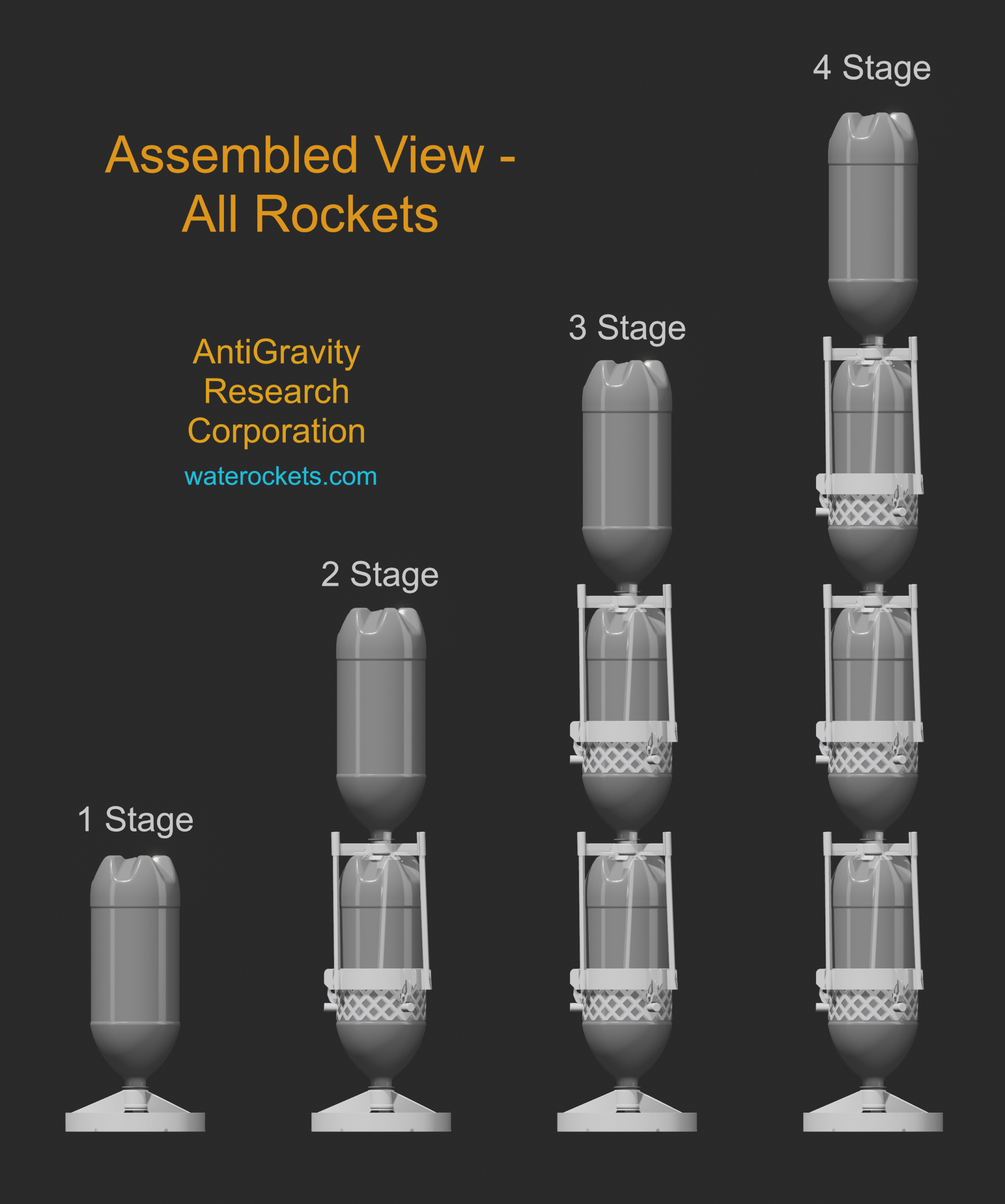
Assembling your Rocket
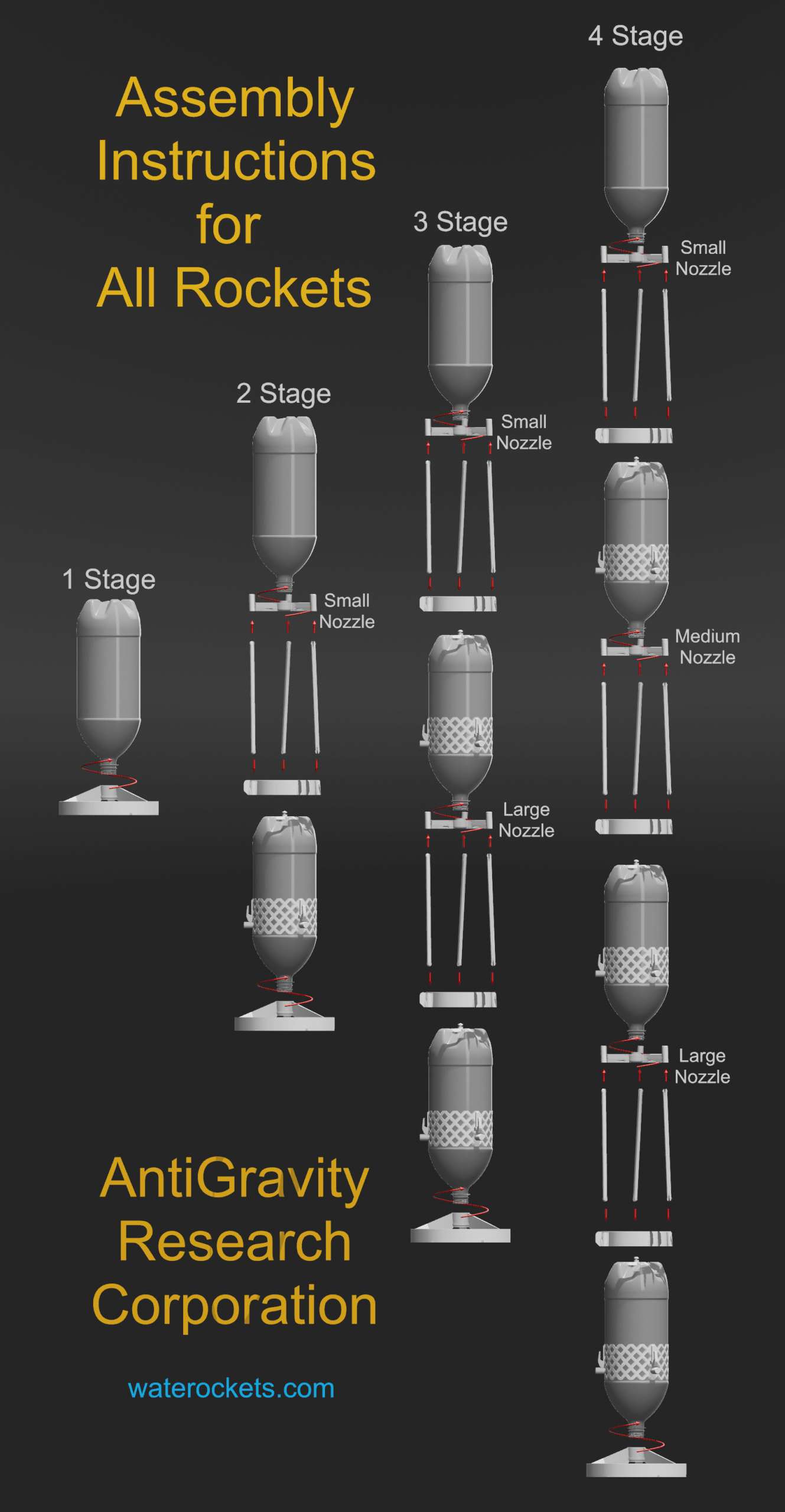
The photo below shows you how to assemble the 1, 2, 3, and 4 stage rockets.
Choose the one that you are building and follow the diagram vertically, ignoring all the others.
Each rod should click into place in the ring fin and the nozzle. Don't worry about the flat sides of the rods; the orientation of the flats doesn't matter.
Once the ring fins are all assembled and connected to their bottles, put the stages together. The nipple at the top of each booster stage should fit into the next nozzle. If it is difficult to insert the nipple into the next stage up, put a little silicone grease (or petroleum jelly or butter) around the nipple to make it slippery.
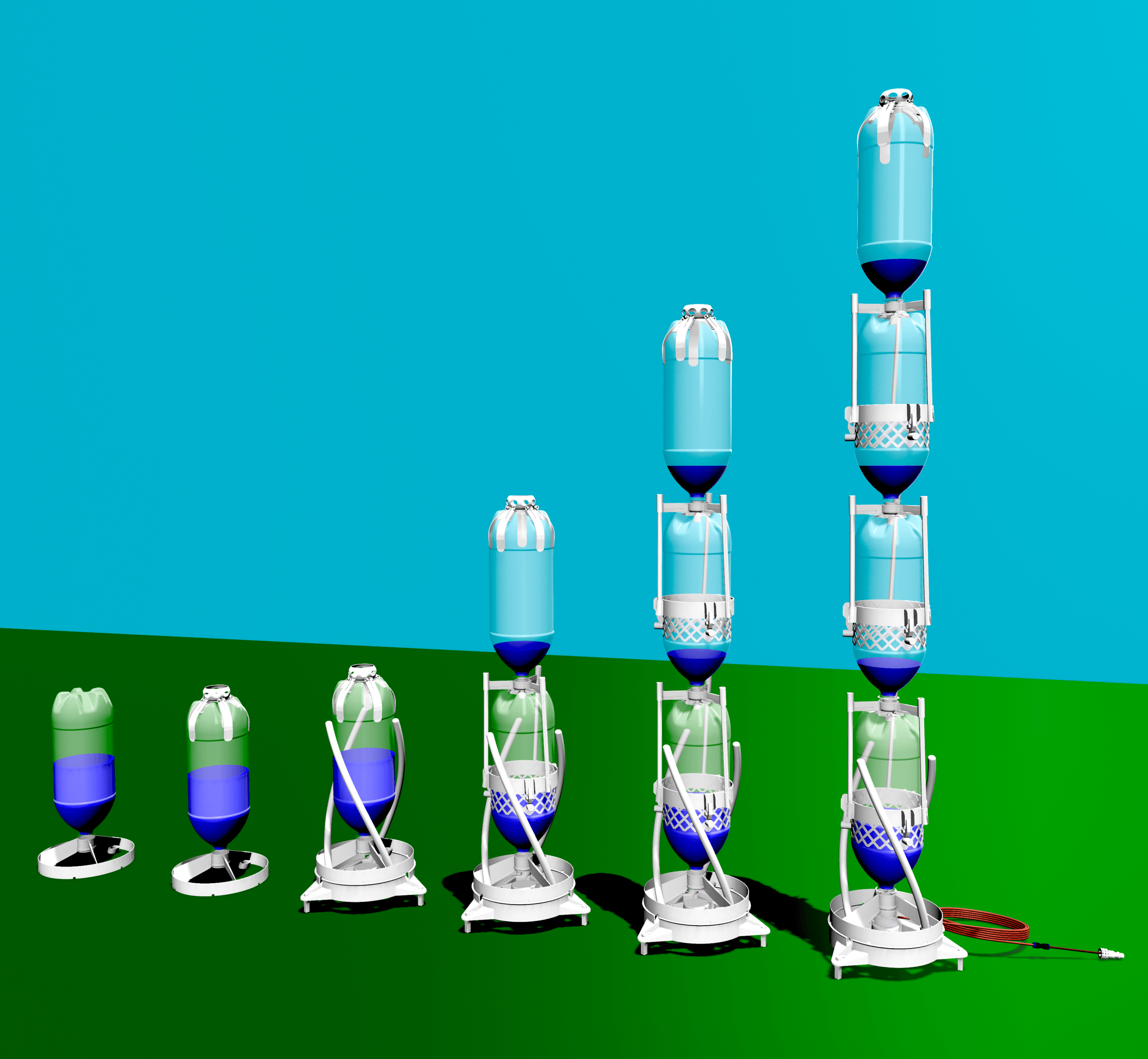
Now your 4-, 3-, 2-, or 1-stage rocket is ready to launch. Here's How to Launch Your Rocket.
AntiGravity rockets are configurable. Any rocket can be configured to be any of the rockets shown to the left of it.
- All rockets can be launched with or without the rotating lander payload.
- All single stage rockets can be launched with or without the spin platform
- Single stage rockets should have 1 litre of water (bottle half full)
- Multi-stage rockets should have 670 ml of water in the bottom stage (bottle 1/3 full), and 200 ml in all the upper stages.
- Don't put too much water in any of the bottles or they can't expel all the water. This can result in a straight-down descent with broken parts.
- Make sure that the spin platform is level, with the bubble in the centre.
- Pump up the rocket with your bicycle pump or your power air compressor. The overpressure valve at the end of the filling hose will whistle when the rocket is at its maximum allowable pressure, and will try to dump all excess air through the whistle. Just disconnect the hose from your compressor or bike pump and the rocket will launch.
- The launcher comes with two connectors: one for your bicycle pump and one that fits most powered air compressor quick-connects.
For safety, stay at least 20 feet away from the rocket when it is being pressurized. The filling hose is 20 feet long so that you can pressurize and launch the rocket from 20 feet away. Make sure that all other people stay at least 20 feet away from it.
- Choose a wide-open grassy field away from buildings, trees, cars, roads, airplanes, wires, and crowds.
- Bring along one or two plastic 2-litre bottles or a gallon milk jug full of water to supply your rockets.
- Don't use any soap in the water for foaming: the foam will cling to the inside walls of the spinning bottle and not come out during the flight. This can cause the top stage to fall straight down instead of sideways, which may damage some of the rocket parts.
- Use a collapsible shopping basket or bag to carry the rocket and water supply.
- Pour the water directly from your supply bottle or jug into the rocket bottle.
- The bottom bottle should be about 1/3 full, or if you are launching a single stage then about 1/2 full.
- All the upper stages should have only about 1 inch to 1.25 inches of water in them (about 200 ml).
- When pouring water into the lower stages of a multi-stage rocket, you should keep a finger over the interstage nipple so it doesn't leak .
- If you are running your rocket with no water it's much quicker to set up and launch, but it doesn't fly as high.
The purpose of AntiGravity water rockets is to provide a tangible, interesting demonstration of the physical laws of motion. We at AntiGravity Research Corporation sincerely hope that the students who experience these rockets will be inspired to pursue studies in Science, Technology, Engineering, and Mathematics.